
Read · For Your Road
There are more good Christian podcasts and books for men than any man can keep up with. We read them, we keep the one in ten worth your time, and we hand it to you for the week you are on. That is the service we open on November 2, and it is the part of our work that goes with you after the room.
A course gives a man twelve weeks. A room gives him one night a week. The rest of the week is where his road is actually walked, and it is where most men lose what they were given. We built something for that stretch and gave it a name: For Your Road. It opens with Breaking Free, matched to the week you are on, and it lives on your own page from the first week. Coming soon: the same reading alongside every course we teach, Known by Jesus, Do Hard Things, Walk With Me and the ones to come, and alongside one-on-one work, so whatever you are in with us, the reading follows that course week by week, and a man in two courses at once is handed one road, not two. The process is simple, and the benefit is yours to keep; both are below, after the voices it draws from.
Our team reads more than a hundred voices across nineteen lanes: the writers and podcasts every morning, and each song once, before any man is handed it. That number will grow: we expect the shelf to reach two hundred voices, and every new one is read by our team before a man ever sees it, so the shelf grows by trust and not by volume. Here is who they are today.
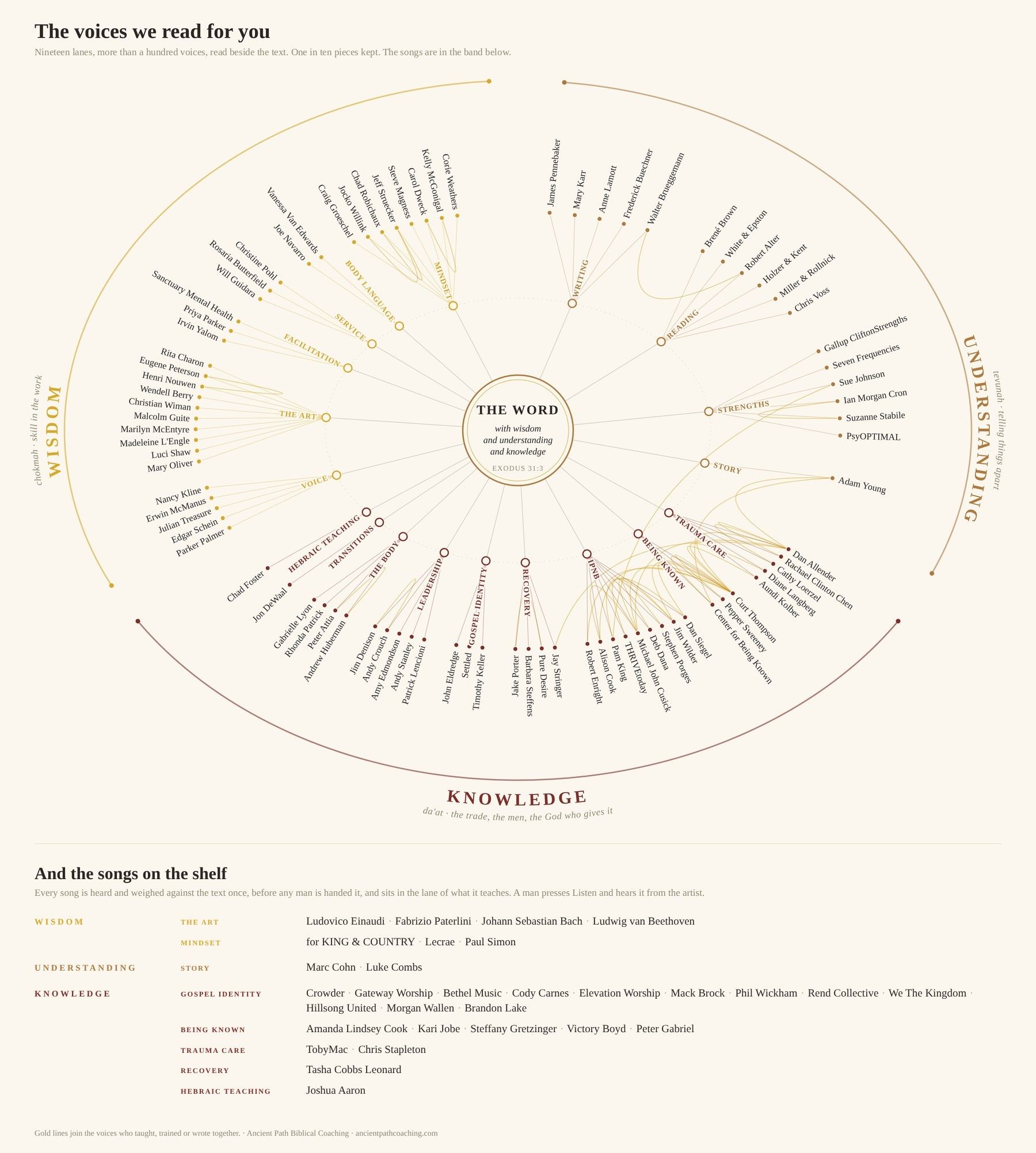
The Word at the center. Three words around the ring, the Bible's own. Nineteen lanes and more than a hundred voices, with the songs in the band beneath the ring, each in the lane of what it teaches. The gold lines join the ones who taught, trained or wrote together: Curt Thompson and Dan Siegel, Jim Wilder and the people who train his relational skills, Dan Allender and the counselors who came up through his center.
Why the Word is in the middle
When God gave Moses the tabernacle to build, he did not hand the work to a priest. He filled a craftsman.
The Hebrew behind that verse gives us the three words on the map, and they are the three things a man actually needs when he is in the middle of his own hard work.
Every voice on the map is read beside the text. When a psychiatrist says shame is a story told over you before you could speak, we set Psalm 139 next to it and see where they agree and where the text says more. When a researcher hands us a tool with Buddhist roots, we say so, take what is true, and leave the rest. The voices carry what they heard. Our words carry what it means and what to do with it.
The nineteen lanes
Each lane is a kind of knowing a man needs on the road, and each one serves one of the three words. They are the shape of our work, so they change slowly; the voices inside them are what grows.
Wisdom · skill in the work
- Voice in the room
- How a man speaks and listens in a circle of men: the question, the silence, being heard.
- What trains the art
- Poets, pastors and writers who train the eye and the ear for another person.Listen Ludovico Einaudi (Nuvole Bianche) · Fabrizio Paterlini (Rainy Days) · Bach (the Aria of the Goldberg Variations) · Beethoven (Heiliger Dankgesang, from his String Quartet No. 15)
- Group facilitation
- How a group holds a man, and how a leader keeps it safe.
- The standard of service
- Hospitality: serving a man past what he asked for.
- Body language
- What a face and a posture say before a word is spoken.
- Mindset
- Discipline, resolve and recovery from coaches, soldiers and athletes, with any tradition named as one.Listen for KING & COUNTRY (Burn the Ships) · Lecrae (I'll Find You) · Paul Simon (The Boxer)
Understanding · telling things apart
- Writing
- Telling your own story on paper, and the evidence that writing it down heals.
- Reading a man
- Hearing what a man is saying, in a story, a question, or a room.
- Strengths and assessments
- The instruments that tell a man and a leader what they are made of.
- Story work
- The early story under a man's present trouble.Listen Marc Cohn (The Things We've Handed Down) · Luke Combs (Even Though I'm Leaving)
Knowledge · the trade, the men, and the God who gives it
- Narrative trauma care
- How harm is carried in a story, and how it is healed in one.Listen TobyMac (Scars) · Chris Stapleton (Broken Halos)
- Shame and being known
- What shame does to a man, and the community that undoes it.Listen Amanda Lindsey Cook (You Make Me Brave) · Kari Jobe (I Am Not Alone) · Steffany Gretzinger (Out of Hiding) · Victory Boyd (I Don't Have To Pretend) · Peter Gabriel (Don't Give Up)
- Interpersonal neurobiology
- How a brain and a body heal inside relationship.
- Sexual brokenness and recovery
- The road out of pornography and betrayal, for the man and for his wife.Listen Tasha Cobbs Leonard (Break Every Chain)
- Gospel identity
- Who a man is in Christ, from preachers who say it plainly.Listen Crowder (Come As You Are) · Gateway Worship (O the Blood) · Bethel Music (No Longer Slaves) · Cody Carnes (Run to the Father) · Elevation Worship (O Come to the Altar) · Mack Brock (I Am Loved) · Phil Wickham (Battle Belongs) · Rend Collective (My Lighthouse) · We The Kingdom (Holy Water) · Hillsong United (So Will I) · Morgan Wallen (Don't Think Jesus) · Brandon Lake with Jelly Roll (Hard Fought Hallelujah)
- Leadership
- What leading people costs and asks.
- The body
- Sleep, food and movement: the bodily side of the fight.
- Transitions
- The in-between seasons of a man's life.
- Hebraic teaching
- The Hebrew words and their first use, the way our courses read the text.Listen Joshua Aaron (Bring Us Back, from Psalm 137)
Read, Listen or Watch
Most of what we hand you is read: an article, a chapter, a few minutes of a podcast. Some of it is a song. A song is the one thing a man carries out of the page without trying, the line and the feeling together, and that is how what you are learning gets heard again on the drive home.
We treat a song the way we treat every voice. Our team hears it and weighs it against the text before it reaches anyone, and it sits in the lane of what it teaches. What reaches you is our few words first: why this song meets you this week, the verse beside it, and what to listen for. Then you press Listen and hear it from the artist. Some of it has no words at all, a piano piece or a movement of Bach or Beethoven; there our words carry the whole connection, and the question we ask back is the word for what it stirred in you.
Nothing plays on its own, nothing runs underneath the page, and we never quote a song. You hear it from the people who made it.
How we keep one in ten
Nine of every ten things we read go nowhere. News without a claim, a launch, a sale, politics, a point our shelf already carries. What stays has to pass one test: could a man change what he does this week because of it. The piece that passes gets a claim in one sentence, the place on the road where it matters, what Scripture says beside it, what we already teach that it touches, the cost in minutes, the twenty minutes of a long episode worth your time, and one thing to do. Since last week it also carries the words themselves: two lines in the speaker's own voice, with the minute and a link, so you hear it from them and can go to the source. A song is the one exception: we never quote it, and you hear it from the artist. We link and we distill. We never take someone's work as ours.
How it works
Six steps, in the order they happen to you.
- You tell us where you are. The course you are in and the week you are on set the ground. You choose a pace: three pieces a week, one a day, or up to two a day, and you can change it any time. Coming soon finish one course and start another, or walk two at once, and the reading moves with you at the same pace, one road.
- Our team reads for you. Every morning we read the voices on the map and keep one in ten, each piece read beside the text.
- A piece reaches your page. It is chosen for that course and that week, so what you read matches what the course is asking of you right now. You see the speaker's own words with the minute and a link (for a song, what to listen for and where to hear it), what it means for the work you are doing, and one thing to do with it before the next time you sit with the men.
- You do the one thing. It is sized for a week, not a life: a question to ask, a verse to read, one man to call.
- Once a week, we ask you one question. You answer in your own words, a few honest lines. Your answers stay on your page, on your own land, as a record of what you did, what you saw and what you know now.
- Once a month, a person reads your road and writes back. Not a score and not a summary of you: a letter from someone on our team who read what you wrote.
What it gives you
Growth, of the kind the three words name. What you hear in the room fades by the weekend unless something reinforces it; this is that layer. Each piece sets an expert's insight beside the week's work, so what you are learning is heard a second time, in another voice, and lands deeper. Over the weeks that is how wisdom, understanding and knowledge grow: not from more information, but from the same truth reinforced until it is yours.
Reading that has already been read for you, by people who know this work, so the piece that reaches you fits the week you are in instead of arriving a month early or a month late. A practice that moves from reading to doing, one thing at a time, so what you heard on a night with the men does not fade by the next one. A record in your own words of what changed, kept on your page, so that at the end of a course you can see your road instead of guessing at it. And a person who knows your road and writes to you by name.
What we ask of you is small and real: read what is chosen for you, do the one thing, and tell us plainly what happened. This is not a feed. Nothing is pushed at you, nothing counts your streaks, and no one else sees what you write. It is the reading a good friend would hand you at the right week, and the question he would ask you after.
When it opens
For Your Road opens November 2 for the men in the Breaking Free room now, and it is theirs for the length of the course. As each course joins, it opens to the men in that course and continues with every course a man takes after. If you have not started, start with a course or one conversation; the road begins at the gate.
Keep reading: Why Do I Care So Much What People Think? · Write a Lament · Our courses